
By: Kara Brown, DBIA Digital Communications Specialist

The U.S. economy added only 22,000 jobs in August, which is below economists’ predictions of 76,500 jobs. According to the report issued by the Bureau of Labor Statistics today, unemployment rose, wage growth stagnated and construction employment fell for the third straight month, signaling a cooling of the U.S. labor force and broader economic strain.
Revised employment numbers for June showed a decline of 13,000 jobs, putting the numbers in the negative, meaning the economy lost more jobs than it gained that month. This is the U.S. economy’s first net loss since December 2020.
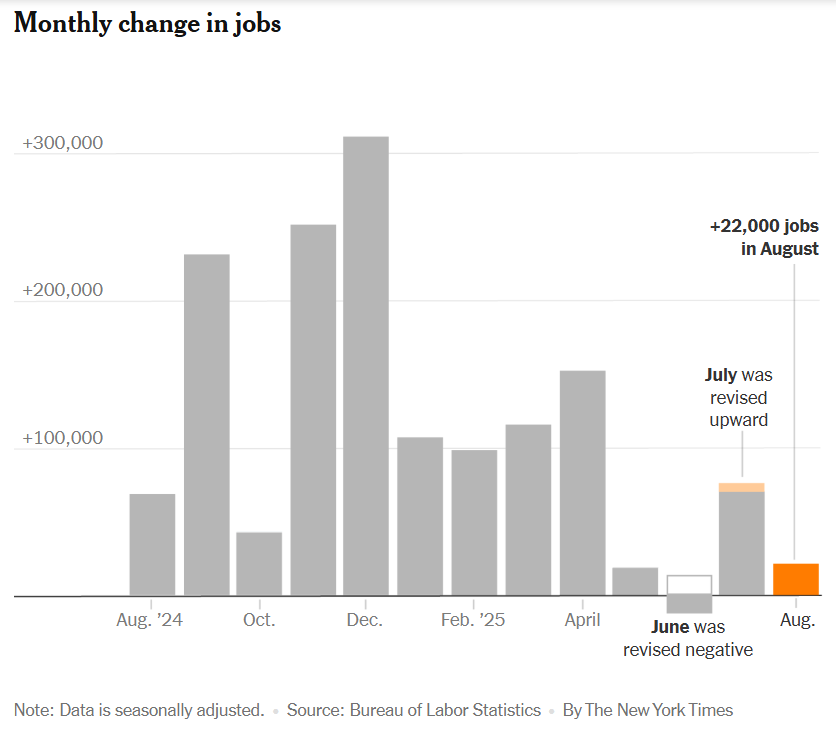
An average of 28,000 jobs were added in total over the course of the past three months ending in July. This is in contrast to the 196,000 added in the three months prior.
The unemployment rate in August rose from 4.2% to 4.3%, and many individuals receiving unemployment benefits are staying unemployed for longer periods as the number of people with continued unemployment claims has risen since April. The increase to 4.3% is noticeable since the unemployment rate has stayed consistently between 3.9% and 4.2% since February 2024.
The job numbers are not showing signs of mass layoffs, but companies are also not hiring at the same rate they were previously. CNN’s Matt Egan explained on News Central that this means companies are either taking a wait-and-see approach or simply playing things safely when considering hiring needs.
Wages also had the lowest growth at 3.7% over the past year since July 2024. The average wage growth per month in 2024 was 4.0%.
Construction Jobs Fell for the Third Month
The construction industry lost 7,000 positions this past month. Non-residential construction employment decreased by 1,200 jobs, and non-residential specialty trade lost 200 jobs.
Residential construction also saw declines, with 6,100 jobs lost in residential construction, 900 in residential building and 5,200 in residential specialty trade contractors.
Many point to immigration policies impacting construction sites, tariffs causing a rise in construction costs and overall economic uncertainty, which makes companies feel less confident in making investments.
However, two numbers in the construction data were promising. The construction unemployment rate dropped to 3.2%, lower than the overall rate across industries. One category within construction added jobs; heavy and civil engineering added 2,300 jobs for the month.
Sector Specific Impacts
Healthcare was the only sector that added a significant number of positions, at 31,000. Nearly every other industry lost jobs.
Manufacturing lost 12,000 jobs, for a total of 78,000 over the course of the year. This continues a downtrend since a February 2023 peak. Uncertainties due to tariffs and consumer spending have prompted some manufacturers to slow hiring.
Federal firing is still having an impact on the economy and job numbers. The federal sector has lost around 10,000 jobs per month this year, with August subtracting 15,000. October’s federal job numbers may potentially see a significant hit since some workers took offersl allowing them to be paid until the end of September.
Are Interest Rate Cuts on the Horizon?
Some economists speculate this is the exact push the Federal Reserve needs to start more significantly cutting interest rates. Many see it as a near certainty that the rates will at least be cut. By how much remains to be answered.