“I need to hire all of them.”
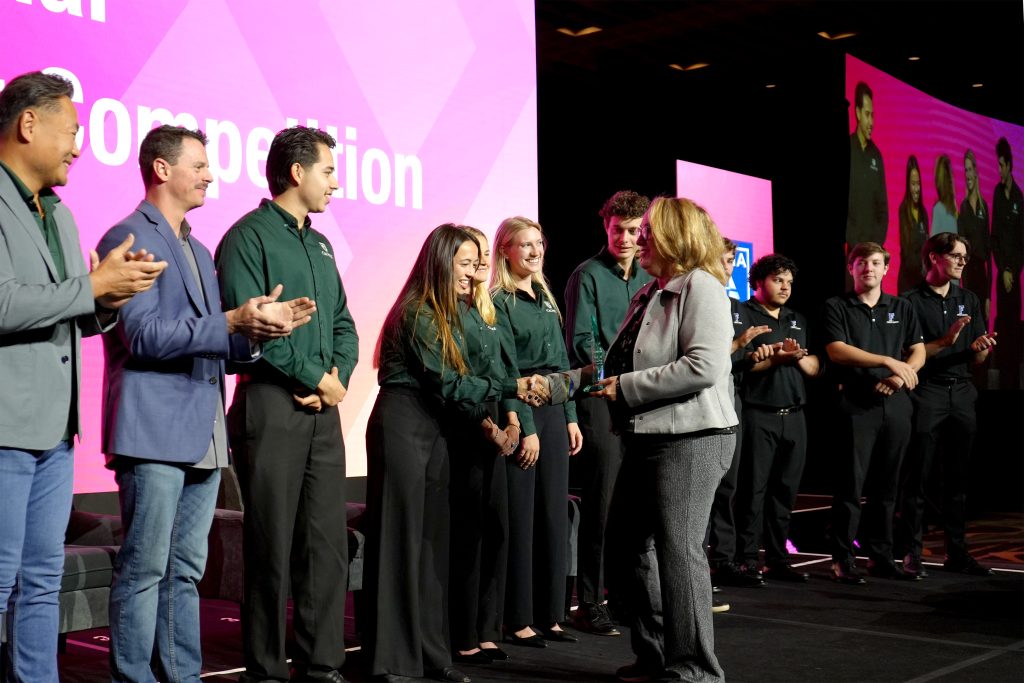
That was the immediate reaction from Virginia McAllister, RA, LEED, NCARB, NCIDQ, DBIA, 2026 National Board Chair and CEO of Iron Horse Architects, watching student presentations at the 2025 DBIA National Student Design-Build Competition.
It sounds like an exaggeration, but it’s the point.
For students entering the architecture, engineering and construction (AEC) industry, the transition from classroom to career can feel like a leap. Even for well-prepared graduates, breaking into the industry and landing that first role can be challenging.
DBIA’s student competition — now open for team registration until Aug. 28 — doesn’t replace that preparation, but it does provide students a hands-on experience that mirrors how the work actually happens. It can also build confidence as students enter a competitive job market and connect them with professionals who can answer questions, offer guidance and mentorship and even help open the door to career opportunities.
Each year, teams from across the country step into a fast-paced, high-stakes environment that mirrors the realities of design-build project delivery, from creating RFQs and RFPs to presenting solutions and defending their approach in front of industry professionals. In each phase of the competition, the students operate very much like the project teams they’ll be part of throughout their careers.
The competition culminates each November at DBIA’s Design-Build Conference & Expo, where the top three finalist teams present live in front of a panel of industry leaders. It’s a high-visibility moment that’s part presentation, part interview, part proof of readiness.
The result is a competition where future hires prove they’re ready.
Registration Your Team Now!
Registration for the 2026 National Design-Build Student Competition is now open through August 28.
A Simulation That’s Not a Simulation
Students from the 2025 finalist teams — including the winning team from California Polytechnic State University, San Luis Obispo (Cal Poly), the University of Florida and Alfred State College — consistently describe the competition as the closest thing to project delivery they’ve experienced.
As Sergio Gonzalez of Cal Poly put it, “it’s real-life exposure and pressure. It showed me this is something I can see myself doing long term.”
That pressure is intentional.
“What makes this competition so realistic is that you have to balance other things going on,” said Coulter Langmaid of Cal Poly. “We have to manage our proposal around classes and other life stuff, and I think that’s a very real scenario in terms of how professionals go about doing bids and proposals for projects.”
The structure itself reinforces that realism. Teams move through the full procurement process — RFQ, RFP, shortlisting and final presentations — mirroring how design-build teams compete for work in the field.
“I think the structure of starting with the RFQ, then the RFP, shortlisting and presenting really reflects how this works in practice,” said Casey Lavin of Cal Poly.
Students from other finalist teams saw the same connection.
“I’ve seen people put together RFPs in my internships, and this is very similar. You’re writing about your company, your design, your schedule and your estimate,” said Owen Lantiegne of Alfred State. “If you’re going into design-build, you’re going to do this kind of work. We’ve already done it once.”
That experience is especially important as design-build continues to grow, requiring new professionals to understand both the technical side of projects and how collaborative delivery works in practice.
For some students, the competition also introduces them to delivery methods they haven’t encountered in their coursework.
“We’re from New York, and design-build is taking off there, but we’re used to design-bid-build, so this was a totally new process for us,” said Selena Fullone of Alfred State. “It gave us the opportunity to really learn it and be able to bring that knowledge into the industry and speak confidently about it.”
Each year’s competition scenario is intentionally designed with that in mind. Rather than hypothetical or academic exercises, students are asked to respond to projects that reflect real industry challenges. Recent competitions have included large-scale infrastructure like airport expansions, while this year’s scenario focuses on delivering a healthcare facility using Progressive Design-Build (PDB), with added complexity around sustainability, site conditions and limited resources.
By working through these types of projects, students learn Design-Build Done Right® and build confidence by tackling realistic challenges in a lower-stakes environment.
Learning How to Work Like a Design-Build Team
Technical skills matter, but DBIA’s National Student Design-Build Competition shows students how those skills come together on a project and how they come together as a team to deliver it.
Students quickly learn success depends on understanding strengths, communicating effectively and working as a unified team, just as they would on a design-build project.
“We all have our own personal strengths, and we work together and we collaborate. We help each other grow with each different skill and every step of our proposals,” said Alyson Buchholz from Cal Poly. “I think it’s just really beautiful to have so much strength and collaboration in one team.”
That interdisciplinary collaboration reflects how design-build teams operate, where alignment, communication and shared decision making are essential from the outset.
For many students, that collaboration extends beyond their immediate team to include Owners and other key stakeholders.
“Design-build is really about that collaboration and those relationships with your client, your Owners and everyone involved,” Buchholz added. “Being part of this competition and working through those conversations is really important for what we’ll be doing in our careers.”
Elijah John of University of Florida agreed. “Sharing our unique perspectives allowed us to create a cohesive project. I come from architecture, but some of my teammates come from construction management. Listening to everybody’s perspective, hearing each other out and playing to each other strengths made our project successful.” The University of Florida placed second in the 2025 competition.
Students also gain experience with the conversations that define project success, like engaging with Owners, responding to feedback and adjusting in real time, but equally important is learning how to communicate those ideas clearly and confidently.
“I think bringing that energy and charisma matters, too,” Gonzalez said. “You want to work with people who want to be there and want to spend time working with you.”
“Reaching out to industry professionals, practicing in front of people and not being afraid to speak up. Those are big parts of this competition,” said Cal Poly Faculty Advisor Bryan Knakiewicz.
For University of Florida student and 2025 Best Individual Presenter winner Asa Richards, confidence comes from preparation and perspective.
“I used to think I had to say everything exactly right,” Richards said. “But the biggest shift for me was realizing I know what I’m doing. I’ve spent hours preparing this with my team. Now I focus on the key points and explain them the way I would to my team. And if something goes wrong, I’ve got people around me who can step in. It’s not all on me.”
Building Confidence and Career Direction
For many participants, the competition even reshapes how they see themselves in the industry. Students who entered their programs without a clear vision often leave with a stronger sense of direction and a clearer understanding of where they fit.
“I thought I would never be doing this, but I loved it,” Gonzalez said. “I’d encourage other students in construction and architecture to do this competition.”
Clarity comes directly from the experience itself. Working through a full design-build process, presenting to industry professionals and navigating real-time feedback helps students build confidence in their abilities and their place in the field.
Others highlight how the competition helps them communicate that value to employers, even without traditional internships.
“At our career fair, I didn’t have an internship last summer, so I felt a little behind,” said Jacquelyn Lomano of Cal Poly. “But when I explained this project — the pressure, working with an Owner, coordinating with our architect — they were like, ‘Wow, that sounds like real life. That’s exactly what I do day to day.’ It really gave us that experience.”
Combined with a clearer sense of direction, the confidence they gain by competing can make a meaningful difference as they enter a competitive job market.
Regardless of how they finish, students leave the competition with hands-on experience navigating procurement processes, a deeper understanding of collaborative project delivery, stronger communication and presentation skills, expanded professional networks and increased confidence in their career path
And perhaps most importantly, they leave knowing they belong in the industry.
Turning Experience Into Opportunity
Experience is just the start. Several of the 2025 finalists described doors opening as a result of their participation. From networking at the Exhibit Hall to conversations with hiring managers, many participants walk away with interviews, internships or even early job offers.
“When you compete in this, you’re like a mini-celebrity [in the Exhibit Hall]. Everybody’s coming up to talk to you,” said Lucas Wicks of the University of Florida. “We had people saying, ‘Come talk to me. Send me your resume. I’d love to connect.’ It almost felt like half job offers. It’s a great professional development opportunity, too.”
University of Florida’s Nicholas Soler echoed Wicks, “We talked to a lot of companies in the Exhibit Hall about internships and future opportunities. They were very open to looking at our resumes and portfolios and potentially bringing us on as interns. We’ll definitely use this experience to keep networking and pursue as many opportunities as we can.”
For some students, those opportunities translate directly into full-time roles.
Langmaid had already secured a spot with Whiting-Turner in Seattle. “It’s for a federal project,” he explained. “I’m excited to get my foot in the door and really grow into my career. I’ve never lived in Seattle. It’s on the other side of the country from where I’m from, but I’m looking forward to it.”
Those interactions often go beyond quick introductions. Students begin building relationships with industry professionals who can answer questions, offer guidance and stay connected beyond the event.
And sometimes, those connections start immediately.
During our interview with the Cal Poly team, Lomano paused mid-conversation.
“Speaking of working with people,” she said, “I actually have to go meet with someone about a job.”
We didn’t ask if that someone was McAllister.