
Leadership in design-build doesn’t look the same everywhere. Sometimes it’s a legislator shaping the policy landscape. Sometimes it’s an Owner setting the tone for trust and partnership. Sometimes it’s an industry veteran guiding the next generation or a young professional already leading with vision.
That spectrum of leadership is what DBIA’s Distinguished Leadership Awards celebrate each year, and DBIA is proud to present Jennifer Macks, PE, LEED AP, DBIA; Britt Sanford; David Shadpour, PE, CPD, LEED AP, DBIA; and Janice Zahn, PE, CCM, with the 2025 Distinguished Leadership Awards. Across the industry, these honorees exemplify how design-build continues to evolve through people willing to lead boldly, listen closely and act with integrity.
Get to know the recipients:
Industry Impact: Jennifer Macks, PE, LEED AP, DBIA
Category: Industry Practitioner

Jennifer Macks, PE, LEED AP, DBIA, is recognized as a forward‑thinking leader within DBIA. She chaired the 2023 and 2024 DBIA Design-Build Conference & Expo Planning Committees and served on the Education Committee during major updates to the Universal Best Practices, Core Certification Curriculum and Exam Prep Course, work central to how DBIA serves the industry. Colleagues describe her as someone who brings a fresh perspective and challenges the status quo in ways that strengthen teamwork and outcomes.
For Macks, the Distinguished Leadership Award reflects the same values that have defined her career: collaboration, innovation and mentorship. “It validates the work I’ve done to advance Design-Build Done Right® and highlights the collective achievements of teams I’ve led and learned from,” she said.
Over her 30-year career, Macks has guided large, complex projects and championed innovations that streamline operations and elevate performance for clients and partners. Today, she is Vice President and Business Unit Leader at HITT Contracting, leading the Austin office and overseeing teams that deliver high-quality, forward-looking construction solutions. Her blend of technical expertise and business acumen has established her as a trusted voice in the field.
Macks has played a key role in shaping DBIA’s education initiatives. “We’re no longer just teaching the fundamentals of design-build,” she said. “The shift toward more experiential learning, case studies and cross-discipline training ensures future design-build leaders are better equipped to navigate challenges in real time.”
She added, “It’s exciting to see participants connect lessons learned directly to their own projects. That’s when you know the education is working.”
Having worked on design-build projects for more than two decades, she’s seen the growing recognition of the integrator’s role in project success. Looking ahead, she believes the next frontier lies in how teams leverage AI to improve project execution. “This will enhance coordination and communication,” she noted, “enabling the design process to remain iterative while revisions and adjustments are integrated more seamlessly with the design-builder’s workflow.”
She’s also encouraged by the rising value of DBIA Certification, calling it “a true differentiator in the market” that demonstrates a commitment to design-build’s collaborative culture.
Macks often encourages leaders to understand how their colleagues across disciplines approach their work. Early in her career, she spent time in an architect’s office, gaining a deeper appreciation for their process. “It helped me better understand how to provide information that was truly useful to them,” she said. That perspective continues to shape how she collaborates today, ensuring every team member has the insight needed to succeed.
Beyond her technical and leadership achievements, Macks is a passionate advocate for mentorship, talent development and equity in the workplace. “Receiving this award motivates me to continue giving back to the industry, mentoring the next generation and working to ensure the future of design-build remains strong,” she said. She’s widely recognized for cultivating inclusive environments that empower emerging professionals and strengthen the future of collaborative delivery.
The Owner’s Responsibility: Britt Sanford
Category: Owner
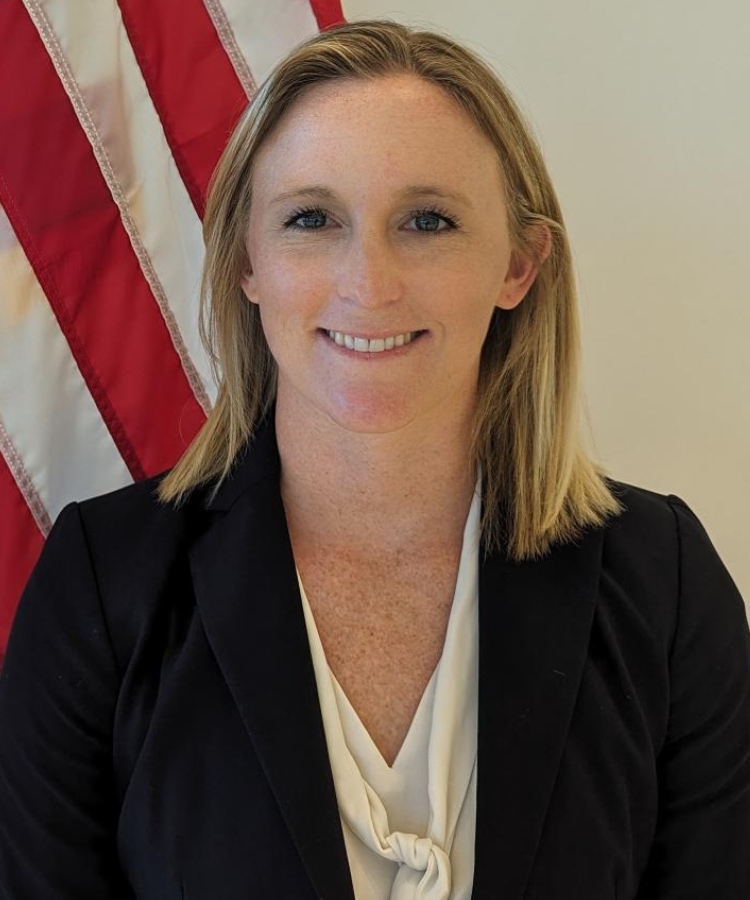
Britt Sanford said receiving the Distinguished Leadership Award was unexpected but deeply meaningful. “It’s inspiring to see how even small contributions can make a difference,” she said. Sanford believes the recognition reflects the growing understanding of the vital role Owners play in driving collaboration and setting the tone for project success.
With leadership experience at both the FBI and NASA, Sanford has seen firsthand that culture change must start within the organization. “Owners can’t expect excellence from external partners without first cultivating it internally,” she said. That philosophy has guided her approach to ownership: build alignment within teams first and external partnerships will thrive as a result. “When teams truly embrace design-build principles, they grow together,” she said. “That internal alignment becomes the foundation for strong external partnerships.”
Sanford also sees design-build’s influence expanding well beyond traditional construction. “I believe we’re only at the beginning of this transformation,” she said. “As agencies continue to seek greater efficiency and collaboration, I expect design-build strategies to become more widely adopted, not just in construction but across other procurement areas as well. I’ve even begun exploring how these principles can be applied beyond their conventional boundaries.”
Her projects, from NASA launch pads to FBI facilities, show how trust and transparency can turn complex work into opportunities for innovation, but she’s quick to emphasize that innovation doesn’t happen by accident. “Momentum matters,” she said. “Move quickly, and your partners will match your pace. The project will be better because of it.”
As a Contracting Officer at the FBI, Sanford helped lead an $82 million National Security and Intelligence Center of Excellence using design-build delivery, aligning scope, schedule and performance through a sophisticated award-fee incentive structure. The project was completed within budget in under nine months despite difficult market conditions and now serves as a model for future NASA projects on Redstone Arsenal in Huntsville, Alabama.
Her advocacy extends beyond project execution into education and culture change. “Design-build best practices start from within the agency,” Sanford said, “and Owners must be willing to invest in training and preparation and embrace missteps. Not every project will be flawless and not every voice will agree, but progress comes from resilience and shared commitment.”
In the past 18 months, Sanford has supported NASA’s construction division through the two-phase design-build process, hosting weekly virtual sessions and quarterly in-person workshops to shape requirements and RFPs. She participated in DBIA Owner’s Bootcamp training at Kennedy Space Center and continues to advise NASA teams as they adopt Design-Build Done Right® principles. In spring 2025, she trained more than 40 professionals at USACE Savannah District, including contracting officers, legal representatives, project managers and engineers, an effort that helped launch a pilot program applying DBIA best practices.
She often says, “You have to keep the fire alive within the agency before you can build it with others,” a philosophy that underscores her approach to sustaining collaboration and trust within teams.
A Rising Voice: David Shadpour, PE, CPD, PMP, LEED AP, DBIA
Category: Young Professional

For David Shadpour, PE, CPD, PMP, LEED AP, DBIA, receiving the Distinguished Leadership Award is both humbling and energizing. “It reinforces the importance of building strong relationships and continuously investing in knowledge,” he said. “It validates the efforts of my team and our commitment to advancing design-build practices that deliver efficient and innovative outcomes. It also motivates me to keep mentoring and supporting the next generation of leaders in our industry.”
A dual-licensed mechanical and electrical engineer, Shadpour serves as Executive Project Manager at Shadpour Consulting (SC) Engineers, where he also chairs the firm’s Innovation and Education Committee. In that role, he’s helped embed design-build principles into every layer of practice, from workflow integration to team culture. His leadership extends across the federal, healthcare and higher education sectors, where he has led projects emphasizing collaboration and sustainability.
Shadpour’s work on the U.S. Coast Guard’s Consolidated Base Administration Facility in Charleston, South Carolina, stands out as a defining example. The net-zero energy project united stakeholders early, aligned performance goals and delivered a resilient, cost-effective facility that exceeded federal energy standards. He’s applied similar principles to projects at Rady Children’s Hospital and San Diego State University, advancing lean coordination modeling and AI-assisted processes to reduce rework and improve communication. Shadpour’s nominator said, “David’s leadership shows how design-build can be practiced, scaled and taught with purpose, precision and long-term impact.”
Reflecting on his career, Shadpour said, “I’ve seen design-build shift from an alternative delivery method to the preferred approach for many clients. Greater collaboration between Owners, contractors and design teams has produced more efficient, cost-effective and sustainable results.”
Beyond his technical work, Shadpour is a strong advocate for education and mentorship. He teaches courses at San Diego State University and UC San Diego Extended Studies, encouraging engineers to approach design-build as a mindset rooted in systems thinking, empathy and integration. His TEDx talks on net-zero energy and climate action have reached international audiences, inspiring both professionals and students to think critically about the built environment’s role in sustainability.
When asked about the future of design-build, Shadpour acknowledges the growing role of technology but emphasizes balance. “Technology like AI and advanced modeling will play an even bigger role, but the human side of collaboration remains just as critical,” he said. He believes the next generation of engineers will bring curiosity, collaboration and a knack for technology that will redefine what’s possible. “I see them shaping how projects are delivered while also challenging our industry to think bigger about innovation and responsibility to communities,” he said.
To prepare that next generation, Shadpour encourages other young professionals, students and apprentices to “stay curious and committed to continuous learning.” He believes innovation and true partnership can only thrive when there is trust, respect and empathy among team members. A firm believer in leading with humility and a service mindset, he says that approach “creates space for both people and projects to thrive.”
Policy with Purpose: Janice Zahn, PE, CCM
Category: Legislator

Janice Zahn, PE, CCM, brings a global perspective and a lifetime of lived experience to her work in public service. For her, the Distinguished Leadership Award celebrates a career devoted to transforming how Washington builds. “Design-build gets us back to the old master builder model,” she said, “where all the people who can bring their best ideas come together from the very beginning. Through that collaboration, we get more together than we do alone.”
Appointed in 2024 and elected later that year to represent Washington’s 41st Legislative District, Zahn quickly became a pivotal voice for infrastructure innovation. In her first session, she sponsored and passed two landmark bills modernizing public procurement: HB 1967, eliminating bonding requirements for the design and preconstruction phases of design-build projects and HB 1970, granting full authority for Progressive Design-Build (PDB) on Washington State Department of Transportation projects. “When I got to Olympia, I realized there were few legislators with engineering backgrounds,” she said. “That practitioner perspective matters. It allows us to craft policy that actually reflects how projects succeed in the real world.”
Zahn’s impact extends beyond policy, rooted in her belief that design-build’s greatest strength lies in its human element. She often emphasizes that collaboration requires trust, humility and the willingness to listen. These are values she carried from engineering into public service. “When we approach projects with curiosity instead of control, we find better answers,” she said. “Collaboration isn’t just a process; it’s a mindset that lets us create something greater together.”
A longtime member of the DBIA Northwest Region Board and past Chair of the state’s Capital Projects Advisory Review Board (CPARB), Zahn helped shape Washington’s reputation as a national leader in collaborative delivery. Through CPARB’s Design-Build Best Practices Committee, she led training sessions for Owners and practitioners, advancing DBIA-aligned processes and expanding small-business participation and workforce development in public projects.
Before joining the Legislature, Zahn built a distinguished career as Chief Engineer at the Port of Seattle, overseeing internal design, construction management, survey and safety and delivering projects for Seattle-Tacoma International Airport, the Maritime division and Northwest Seaport Alliance. She also served on the Bellevue City Council, focusing on housing affordability, climate action and transportation equity. She earned Bachelor’s and Master’s degrees in Civil Engineering and a Master’s in Public Administration from the University of Washington, grounding her leadership in both technical expertise and vision.
Zahn continues to champion equitable access to design-build, emphasizing how it empowers smaller jurisdictions to manage complex projects with limited staff capacity. “The traditional way of delivering doesn’t satisfy the challenges we have today,” she said. “Progressive Design-Build allows us to maximize limited resources while achieving our environmental and workforce goals.”
Her advice to emerging leaders is simple: start with collaboration. Having completed DBIA’s Collaborative Delivery Leadership Academy, Zahn believes effective leadership begins with trust, communication and shared purpose. She even brought those classes to the Port of Seattle, expanding them across departments to strengthen internal teaming. “It’s not about having a tagline,” she said. “It’s about each of us showing up in ways that model collaboration and accountability.”
Zahn’s story proves that leadership grounded in technical expertise and collaboration can move policy and an entire state forward.
Together, Zahn, Shadpour, Sanford and Macks illustrate that leadership in design-build is as diverse as the projects and communities it serves. Their stories remind us that whether through policy, ownership, industry practice or emerging voices, design-build thrives when leaders commit to collaboration and innovation.
The Distinguished Leadership Award winners will be honored during DBIA’s 2025 Design-Build Conference & Expo in Las Vegas, November 5–7.
