How design-build and intelligent automation can help construction overcome persistent productivity challenges.

Construction cost data from the Bureau of Labor Statistics and Construction Analytics suggest that, since the 1970s, the prices Owners pay for building have risen significantly faster than inflation, building materials and construction wages. A recent Building CATALYST analysis of 35 hospital projects indicates an even more alarming increase, with healthcare systems — and ultimately taxpayers — paying more than triple what inflation alone would suggest.
The analysis also points to correlations between excessive costs, misaligned incentives and limited access to objective project data. Since 2018, cost escalation on large, complex projects appears to have accelerated sharply.
In 2017, McKinsey described construction as stuck in a “time warp.” Addressing the industry’s persistent inefficiencies requires a more integrated approach to project delivery. Systems-based design-build provides that foundation, combining intelligent automation with aligned, value-based incentives to improve decision-making and reduce waste.
Intelligent Automation System
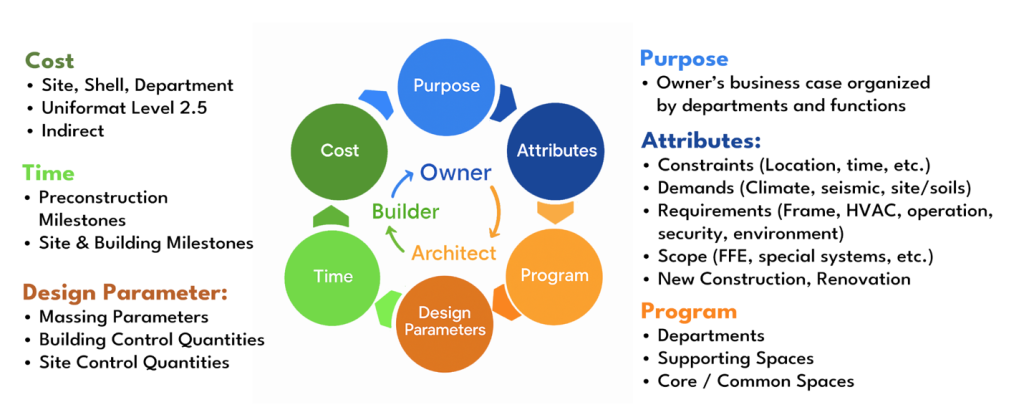
An Intelligent Automation System (IAS) organizes and networks planning, design and construction data into six critical data groups, as shown in Figure 1. Together with structured data standards, this network creates the technical infrastructure — the engine — that powers automation and enables the acquisition, processing and analysis of objective knowledge and market intelligence.
Starting in the early planning stages, IAS enables real-time program-to-cost modeling and rapid set-based comparisons to inform critical decisions. When combined with aligned incentives, it creates a Construction as a System approach that supports value optimization and measurable process improvement.
These three short Building CATALYST videos illustrate the potential of IAS, particularly two of its transformative capabilities: knowledge (market intelligence) and automation.
- From Silos to a System – hows the vision for a data-driven knowledge system that serves as the foundation for Intelligent Automation, connecting data, knowledge and insights to drive measurable process and value improvement.
- River Stop Medical Center – Illustrates real-time planning, programming and cost modeling
- Gateway Tower – Illustrates rapid scenario planning and comparative conceptual design across three sites.
As these videos illustrate, IAS could reduce the dozens of decision-making cycles from days or weeks to hours, or potentially real-time. The implication is profound in reducing layers of waste in time and cost throughout the planning and design stages.
Since conventional bifurcated design and delivery approaches are not well suited for systems integration and automation, we look to an advanced form of design-build to implement the IAS.
A System-based Design-Build Solution
Inherently and conceptually, design-build is a well-suited contracting framework for a holistic, highly automated planning, design and construction process. Practically and technically, however, realizing its full potential requires five key advancements:
One Operation and Knowledge System – Key team members must operate within a shared operating system that includes:
- Consensus Data Standards and Structures – Establishes common data standards organized into six categories: Purpose, Attributes, Program, Design, Schedule and Cost, as illustrated in the From Silos to a System video.
- Common Data Processing, Automation and Knowledge Centers – Most teams already use shared document centers, such as Procore. A dynamic, intelligent automation system must also be incorporated, as illustrated in the River Stop and Gateway Tower videos.
Internal (In-house) and/or Master Multi-project Organization Structure – Design-build arrangements in which the architect works under the builder, or a special purpose entity (SPE) is established for a single project, do not necessarily provide the integration needed for systems-based delivery. In-house design and construction teams or multi-project master agreements are better suited to implementing a shared operating and knowledge system.
Aligned Extrinsic and Intrinsic Motivation Framework – Compensation models based on project costs and billable hours can discourage the efficiencies that systems-based design-build seeks to achieve. Stipulated-sum and value-based contracting, applied at the services or total-project level, can provide financial incentives to improve return on effort while reinforcing the intrinsic motivation to enhance owner value and pursue excellence.
Whole Project / Building Value Optimization Orientation – Design-build provides a framework for teams to optimize the project as a whole rather than its individual parts. Systems thinking begins with executive leadership and extends to project teams, creating opportunities to consolidate overlapping support functions in the field, office and corporate operations.
Sustained Measurable Process/Value Improvement Platform – Design-build’s multidisciplinary structure supports the development and implementation of process improvements across projects. Rather than reinventing solutions for each project, teams can develop proven approaches and apply them repeatedly. With a shared operating system, organizations have the tools and incentives to drive measurable improvements, from major breakthroughs to continuous, incremental gains.
Together, these five advancements can equip project teams to automate processes, improve performance and systematically reduce waste in time and cost, beginning with planning and continuing throughout the project lifecycle.
Visit www.buildingcatalyst.com to learn more or explore a pilot initiative.

Mark Sands, Building CATALYST
Mark’s background includes BS in Civil Engineering, MBA, and Professional Engineering licensure. In 2003 Mark semi-retired to develop an Intelligent Automation System (IAS). Today he is advocating for reform to integrate, automate, and drive measurable process improvement in planning, design and construction.