These young professionals are making themselves known as leaders in the AEC industry with the help of DBIA programming and educational resources.
Contributors: Eden Binder, DBIA Communications and Advocacy Associate, and Kara Brown, DBIA Digital Media Specialist
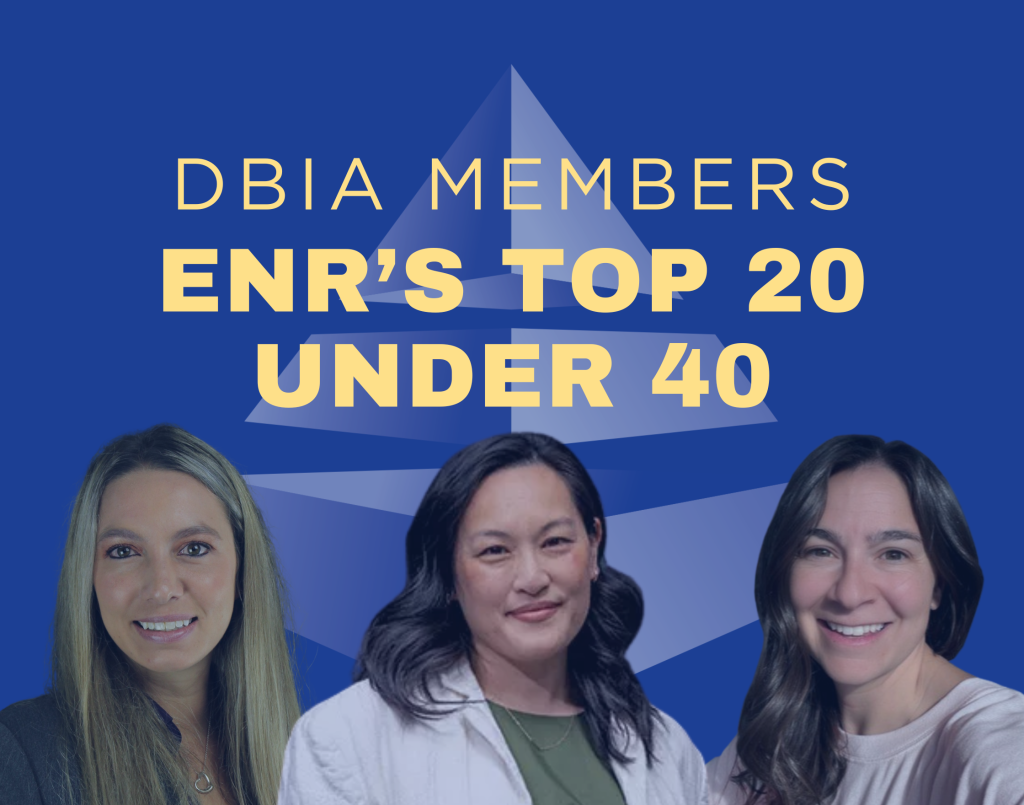
DBIA members Michelle Hoysick, Amber Smith and Tiffany Mok earned spots on this year’s Engineering News-Record (ENR) Top 20 Under 40, which recognizes emerging leaders across the AEC industry.
Smith is marketing director at Kiewit, Hoysick serves as business development director at AECOM and Mok is a senior design manager at Hensel Phelps. Their career paths reflect the increasingly varied backgrounds, skillsets and leadership styles shaping the next generation of the AEC industry.
Different Paths into the Industry
While their career paths differ significantly, Smith, Hoysick and Mok reflect the increasingly broad range of backgrounds and experiences shaping both DBIA membership and the next generation of AEC leadership.
Smith said her career has been shaped less by following a traditional path and more by recognizing gaps where communication and strategy could better support technical teams and clients. After earning degrees in real estate, business development and international business, Smith entered the AEC industry by supporting Kiewit through her independent advertising agency, CoCoSol. She later joined the company full time and helped build Kiewit’s dedicated infrastructure marketing group.
Hoysick began her career during the post-2008 recession, when many young professionals struggled to find opportunities in the field. She graduated from the Colorado School of Mines and joined Denver’s Regional Transportation District as an intern, where she gained experience in design review and field construction management while working on major transportation projects across the Denver area.
Mok graduated from the University of California, Berkeley, with a degree in architecture and built experience managing multidisciplinary teams across international projects and large-scale developments. Today, she serves as lead design manager for Hensel Phelps on the $1.5 billion LAX Terminal 5 redevelopment project and has also supported mentorship and leadership initiatives for emerging professionals in the real estate and development industries.
Though their paths into the industry varied widely, each has built a career shaped by collaboration, adaptability and a willingness to step into increasingly complex challenges.
Communicating Complex Work
Smith said receiving ENR’s Top 20 Under 40 recognition reinforced the value of nontraditional leadership roles within the AEC industry.
“The industry still needs storytellers. We still need translators and strategists and communicators,” Smith said. “I think the difference is our advantage.”
As projects and delivery methods grow increasingly complex, communication skills are becoming a more central part of project leadership across the AEC industry.
Smith said much of her work focuses on helping technical teams break down complex delivery strategies and project goals into more accessible, client-focused messaging.
“Engineering and construction projects are incredibly technical, but at the end of the day, projects aren’t just won on technical merit,” Smith said. “They’re won on trust, clarity and whether the client understands how your team will solve their problem.”
Hoysick said communication is also critical when helping clients, agencies and communities understand the broader impact of complex infrastructure projects.
“We aren’t just selling engineering services. We are selling a vision of a better future,” Hoysick said.
For Smith, DBIA resources have also helped her better communicate collaborative delivery approaches such as progressive design-build (PDB) to clients and project teams. She pointed to Kiewit’s kiewitlearning.com platform as one example of how her team has worked to make increasingly complex delivery methods easier to understand for both clients and industry partners.
In an ENR profile, Mok also emphasized the importance of communication and collaboration on large-scale projects and multidisciplinary teams.
“If people can’t communicate together, that really is how projects fail,” Mok said.
For many emerging leaders, communication and collaboration skills are developed alongside increasingly broad project and delivery experience.
Adaptability and Collaboration
Hoysick said early career exposure to both field construction management and design review helped shape the way she approaches project delivery and leadership today.
After working on major transportation projects across the Denver area, she later moved into roadway design and alternative delivery strategy at Michael Baker before joining AECOM. Hoysick also worked on the Utah Department of Transportation’s US-89 project, widely recognized as the nation’s first PDB transportation project.
She said her experience across multiple sides of the industry helped accelerate her growth early in her career.
ENR Top 20 Under 40 judge Jake Schmidt, project development manager at FCI Constructors, said many of the candidates who stand out are already leading increasingly complex projects early in their careers.
“You’re seeing all these amazing things that the candidates are accomplishing in these extremely complex projects that they’re on, that they’re leading,” Schmidt said. “They’re not just middle-tier people; these are their projects and their efforts.”
Hoysick said younger professionals benefit from staying open to different experiences and opportunities early in their careers.
“When you’re young, and you have energy and you’re just trying to see what’s out there, take advantage and say yes as much as possible,” Hoysick said.
As careers progress, however, she said professionals also learn the importance of knowing when to say no and focusing their energy on the opportunities that create the most personal and professional value.
Mentorship and Leadership
Mentorship, advocacy and creating opportunities for younger professionals were common themes throughout this year’s ENR Top 20 Under 40 profiles.
Hoysick credited early mentors within the transportation industry for helping shape her career during the post-recession years of her entry into the field. She said learning when to say no and where to focus your energy is often the kind of perspective gained through experience and guidance from the professionals who came before you.
Schmidt said one of the qualities that consistently stands out among ENR Top 20 Under 40 candidates is a willingness to support and develop others in the industry.
“I love the ones who are leading, but I also love the ones who are mentoring,” Schmidt said. “It’s obvious they’re trying to build the next group of extremely successful young individuals.”
In her ENR profile, Mok emphasized leadership rooted in empathy, communication and advocacy, particularly for younger professionals navigating high-pressure project environments. In addition to mentoring emerging professionals through industry organizations and leadership initiatives, Mok said strong leadership often comes from authenticity and trust-building rather than formal titles alone.
“Leadership and management are two different things, and you can be a leader without being a manager,” Mok said. “It really just takes being authentic and courageous and present enough to dive in.”
Smith similarly encouraged younger professionals to learn from experienced industry veterans and seek out perspectives beyond their immediate roles or career ambitions.
“Go talk to the people who’ve been here the longest,” Smith said in her ENR profile. “You won’t just build deeper relationships; you’ll hear stories that reshape how you view the company and your role in it.”
Such evolving perspectives are also influencing how the next generation approaches project delivery and leadership in an industry that perpetually changes.
Industry Evolution
Hoysick said experience with PDB has become increasingly valuable as alternative delivery expands across the transportation sector.
“There’s been a huge movement, especially across the Midwest and the West as progressive design-build has become more and more common,” Hoysick said. “So having that background has been really helpful as the PDB market continues to grow.”
That growth extends beyond transportation. Mok’s work on the $1.5 billion LAX Terminal 5 redevelopment project — which is being delivered ahead of the 2028 Olympic Games in Los Angeles — reflects the increasing scale, speed and complexity of collaborative infrastructure delivery across the aviation sector.
Smith said helping clients understand evolving delivery approaches has become a growing part of her work. “We take complex concepts and break them down into bite-sized, digestible pieces that anyone can understand,” Smith said.
She added that younger professionals are also entering the industry with changing expectations around communication, technology and access to information. “You have to have the patience enough to learn it but also be confident enough to help evolve it,” Smith said.
Schmidt said younger professionals also benefit from finding organizations willing to give them meaningful responsibility early in their careers.
“Don’t necessarily wait for your turn,” Schmidt said. “Challenge the industry and want more and surround yourself with a culture and an organization that’s willing to give you as much as you can handle, if not just a little more.”
The Role of DBIA
For the DBIA members recognized by ENR this year, DBIA has also played a role in supporting collaboration, professional development and industry connections throughout their careers.
After managing multiple design-build projects, Schmidt said he turned to DBIA resources like Primers, Deeper Dives and contracts to better understand both the contractual and collaborative aspects of project delivery.
“I needed the tool sets to be able to navigate the right contract challenges and to be able to streamline processes and integrate design control on the front end,” Schmidt said. “DBIA provided an extremely valuable library and kind of course work catalog for me to understand how I could do design-build at a level where I could better serve our clients.”
Smith said DBIA materials and educational resources have helped Kiewit refine how the company communicates collaborative delivery approaches to clients and stakeholders, influencing everything from client messaging to award submissions and presentations tied to alternative delivery work.
Hoysick said DBIA’s Design-Build for Transportation/Aviation Conference has become an especially valuable networking and collaboration opportunity for professionals working in alternative delivery.
“Attending the DBIA transportation conference every year is one of the premier networking events for us,” Hoysick said. “Those three days are jam-packed with content from the conference and meetings. The networking value DBIA brings has been really, really important.”
As younger professionals continue shaping the future of the AEC industry, DBIA is also evolving how it supports emerging leaders and early-career professionals.
DBIA recently renamed the Young Professionals member category to NextGen following feedback that the previous name no longer fully reflected how many under-35 members see themselves or their role within the industry. While eligibility requirements are not changing, the new name is intended to better reflect the next generation of design-build professionals shaping the industry’s future.
Through conferences, networking, mentorship and professional development opportunities, DBIA’s NextGen community continues focusing on helping emerging professionals build long-term industry connections and leadership experience.
Meet the Honorees
Amber Smith

Amber Smith is the marketing director for Kiewit’s Infrastructure Engineering group, where she leads strategy across transportation, marine, mining and building markets. With a background in international business and a nontraditional path into the AEC industry, she has built Kiewit’s marketing function from the ground up. Her work focuses on helping technical teams clearly communicate value by supporting pursuit strategy, client engagement and how work is ultimately won.
Education: University of Denver (B.S. Real Estate & International Business), University of Melbourne (M.S. International Business)
Michelle Hoysick, PE

Michelle is a registered professional engineer in the state of Colorado with experience in project management, program management, construction management, civil engineering, inspection and maintenance services for large capital improvement programs. She is experienced in multi-discipline projects using Public Private Partnership (P3), Design-Build (DB) and Progressive Design-Build (PDB). She is a problem solver, innovative team member and client oriented professional.
Education: Colorado School of Mines (B.S. Civil Engineering), University of Colorado Denver (MBA Sustainability)
Tiffany Mok, NCARB, CDT, LEED Green Associate, RA

Tiffany is a senior design manager at Hensel Phelps based out of California as the lead design manager for the $1.5 billion Los Angeles International Airport (LAX) Terminal 5 Redevelopment project, which is targeted for completion before the 2028 Olympic games. She is deeply committed to her community work, much of which is driven by her experience of growing up as a first-generation Asian American woman and the rarity of seeing people like herself reflected in professional leadership.
Education: University of California, Berkeley (B.A. Architecture)