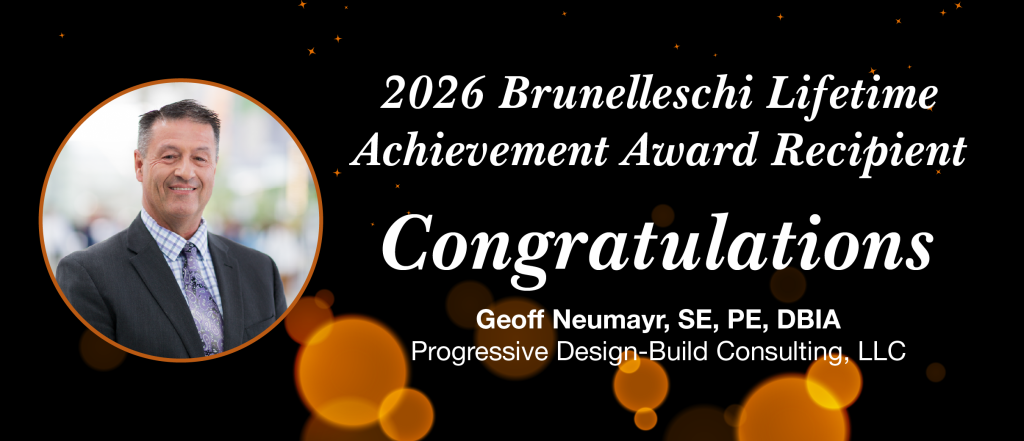
Ask Geoff Neumayr, SE, PE, DBIA, about any of the accomplishments most closely associated with his career, and there’s a decent chance he’ll say the same thing.
“It wasn’t just me.”
The words came almost reflexively as he looked back on efforts to advance virtual design and construction during his time as Chair of DBIA’s National Board of Directors. He says much the same about progressive design-build, describing its evolution through the collective wisdom of people across the industry. Even the expertise others now seek from him, Neumayr describes as a “gift of knowledge” passed to him by countless people throughout his career.
For someone receiving DBIA’s 2026 Brunelleschi Lifetime Achievement Award, the organization’s highest individual honor, Neumayr spends remarkably little time talking about individual achievement.
Those who have worked alongside him, however, are quick to recognize the impact behind that humility.
“Geoff has done far more than help advance progressive design-build. He has shown our industry what it looks like at its very best,” said Lisa Washington, CAE, DBIA Executive Director/CEO. “Throughout his career, he has demonstrated that extraordinary outcomes begin with trust, collaboration and genuine respect for the people doing the work. His legacy can be seen not only in what he helped build, but in the people and teams he made better along the way. It has been a privilege to watch that impact firsthand.”
That may say as much about why he’s receiving the award as the long list of accomplishments itself.
For more than 30 years, Neumayr has influenced the way teams think about design-build, progressive design-build, leadership and collaboration, but running through that career is a notable consistent idea: The best work rarely belongs to one person.
Seeing the Work from Every Side
Neumayr’s career has given him an unusually broad view of project delivery.
He began as a structural engineer and later represented Owners as a project manager before becoming an Owner himself at San Francisco International Airport (SFO). Each role added another perspective on how designers, builders and Owners experience the same project.
His first design-build project came around 1990 on two Bay Area Rapid Transit parking garage projects in Walnut Creek and Concord, California. Design-build was still relatively new in the public sector, and Neumayr saw both its promise and the tension that could arise when teams were asked to make significant commitments before enough information was available.
He also saw something different from the traditional delivery model. Designers, builders and trades were communicating earlier and solving problems together.
Those experiences followed him as he moved into project management and began seeing projects through the Owner’s eyes. Under separate contracts, he saw Owners become what he calls “referees” between designers and builders.
There had to be a better way.
Finding It at SFO
When SFO began another major capital program in the mid-2000s, the airport had already experienced the challenges of traditional delivery, including disputes, litigation and stakeholders who sometimes felt removed from important decisions.
Airport leadership wanted something different.
Hitting schedule and budget goals was a given. The real goal was seeing what the team could achieve together and getting stakeholders involved from day one.
For Neumayr, that meant getting the right people together before locking in all the answers.
That approach became central to SFO’s use of progressive design-build and ultimately extended across a large capital program that included Terminal 2, the airport’s air traffic control tower and Terminal 1.
Even here, Neumayr resists presenting the story as one person introducing a new delivery model to an organization.
He talks instead about leadership that created room to try something different, teams willing to work differently and stakeholders whose knowledge improved the projects.
The method created the framework. The people made it work.
“A contract is just an enabler of good behavior,” Neumayr said.
Collective Wisdom
One phrase comes up again and again when Neumayr talks about leadership: “collective wisdom.”
The idea is simple, but practicing it can be much harder. The strongest answer is unlikely to reside entirely with one person. Teams have to create it together.
For leaders, that means creating an environment where people can raise concerns, challenge assumptions and disagree without allowing conflict to become personal.
When tensions rise, Neumayr’s instinct is to turn the team’s attention back toward what they share.
“We’re in the problem-solving business,” he said.
That philosophy extends beyond the people sitting around the project table.
Neumayr talks frequently about the people who will use the infrastructure the industry delivers, people like passengers, students, researchers, employees and communities. He also points to the tradespeople who ultimately have to build what project teams decide.
“We have the quality of people’s lives in our hands,” he said.
Decisions made early in a project ripple outward. Delays, unresolved conflicts and late changes eventually reach the people responsible for turning drawings and decisions into something tangible.
For Neumayr, listening to more of those voices is not some act of generosity. Ensuring everyone has a part in the project produces better decisions.
Leadership Without Ownership
Neumayr applies this exact mindset to his own accomplishments.
During his 2021 term as Chair of DBIA’s National Board of Directors, he was part of efforts to expand the role of technology and virtual design and construction in design-build.
Asked about his influence on that work, he immediately widened the frame.
“It was a group of us,” he said, describing himself as someone who “just happened to be lucky enough to be the chair that year.”
It’s a revealing response from someone whose career has been defined in part by leadership.
Neumayr doesn’t appear particularly interested in ownership of an idea. He’s interested in whether the idea moves forward.
That’s also how he approaches teaching and mentoring. After years of teaching progressive design-build and advising Owners and teams, he doesn’t describe himself as the person with the answers.
“I feel accountable to making sure that I can share lessons learned and hopefully start a conversation where I learn, too,” he said.
Even what he now brings to those conversations, he credits to others.
“What I really have moving forward is the gift of knowledge from so many people that have taught me,” he said.
Passing It Forward
Neumayr sees the evolution of design-build as a multigenerational effort.
DBIA’s earliest leaders worked to expand legal authority for design-build and educate the industry about a different way to deliver projects. The generation that followed put those opportunities into practice and learned what worked.
The next generation, he believes, has another job.
The challenge is no longer simply knowing how to procure or contract for collaborative delivery. It’s making collaborative behaviors repeatable throughout an entire project and across an industry made up of hundreds of organizations and thousands of people.
Neumayr believes the people coming behind his generation are ready to take that work further.
And again, he doesn’t place himself at the center of what comes next. At most, he sees his generation becoming advocates, passing along what experience has taught them and making room for others to improve it.
A Lifetime of Shared Achievement
Near the end of a conversation spanning his career, Neumayr was asked to forget about projects, titles and awards for a moment.
What did he hope people remembered about him?
His answer had little to do with personal achievement.
“I hope that they know that I was somebody who cared about what we did passionately and who we did it for,” he said.
He talked about the opportunity to do meaningful work with resources entrusted to the industry. He talked about the teams surrounding him throughout his career. He talked about wanting other people to succeed.
“I cared about them, and I cared about our industry, and I cared about what we delivered as projects,” he said.
Perhaps that’s the clearest way to understand Neumayr’s influence.
His career includes projects, leadership positions and ideas that have shaped design-build. Yet when asked to explain how any of it happened, he points outward to colleagues, mentors, project teams, stakeholders and the people who came before him.
The 2026 Brunelleschi Lifetime Achievement Award may carry one person’s name. Geoff Neumayr would probably tell you the achievement behind it belongs to many more.
Neumayr will be honored with the Brunelleschi Award during the Awards Ceremony at the 2026 Design-Build Conference & Expo, Nov. 5, in Cleveland, Ohio.