
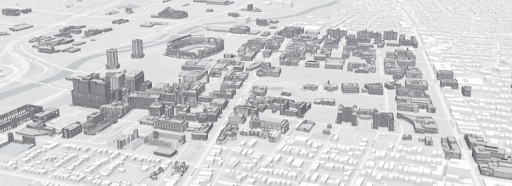
In 2008, The Ohio State University began its journey to becoming a Building Information Modeling (BIM) centric university. We started by investigating the benefits of this technology for our existing buildings, and our efforts ramped up when we published our BIM Project Delivery Standards (PDS) in 2015. After conducting research and working with a consultant, we hired a student to develop a single model of an existing building to demonstrate the real-world benefits of this approach. Based on that successful pilot, we began transitioning in 2011 from 2D AutoCAD floor plans to 3D Revit models. Architecture, interior design and engineering students performed the modeling work under the supervision of full-time staff. Part of what made this process successful was working closely with outside experts to develop standards and repeatable processes for building the models.
Transitioning from 2D AutoCAD to 3D Revit
The transition to BIM for our existing buildings and the use of models received from our BIM PDS has led to several benefits for the university. We have been able to perform early conceptual design work and renovation planning in-house when needed, and much of this work has been completed by a student-staffed design studio, a process that provides them with real-world work experience. Developing these models has also increased the accuracy of the space data, since every building was audited. In addition, significantly more data is incorporated into a 3D model compared to what was contained in a 2D plan, like widows, furniture, exteriors, roofs and heights of assets, allowing for more context when performing facility planning.
Beyond building these basic architectural models of our buildings, we have worked to expand the Revit abilities of different units across campus, such as the College of Engineering, the medical center, facilities planning and Student Life. Facilities Information and Technology Services will train other units in Revit software skills and consult on best practices to increase adoption of the tool to model 3D data where it makes the most sense. In this way, several other units have built on the foundation of these models by creating their own mechanical, electrical, and plumbing (MEP) models, furniture models and equipment models of their own buildings. Overall, this has expanded the BIM ecosystem at Ohio State.
Where Ohio State is Today with BIM
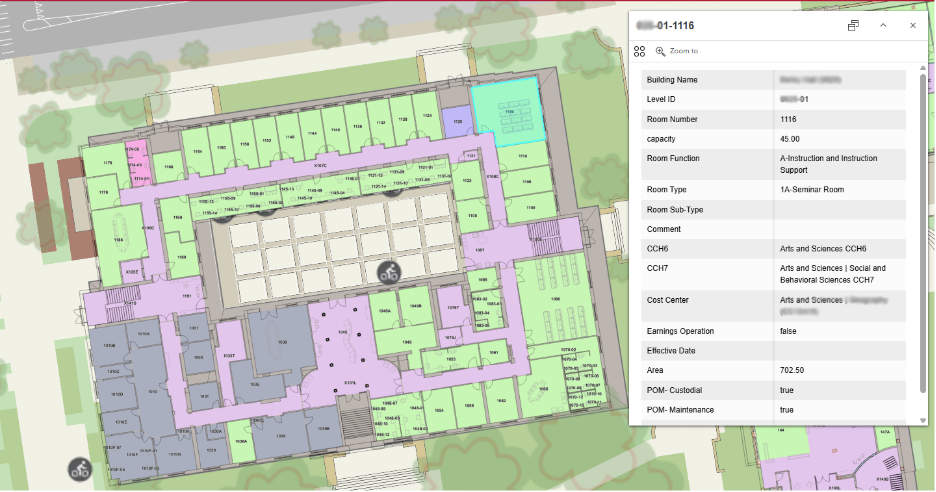
In 2025, we concluded the development of 3D models from 2D plans and are developing 3D models of buildings that have no current plans, with a targeted completion date early this year. At that point, we will have just under 800 buildings covering over 42.7 million gross square feet in Revit. With 97% of the university’s gross square footage now modeled and highly standardized, we are increasingly able to leverage the ‘I’ in BIM. We do that by loading all our models into a database that extracts and organizes all the information enabling campuswide reporting. If a component is modeled, we can report on it.
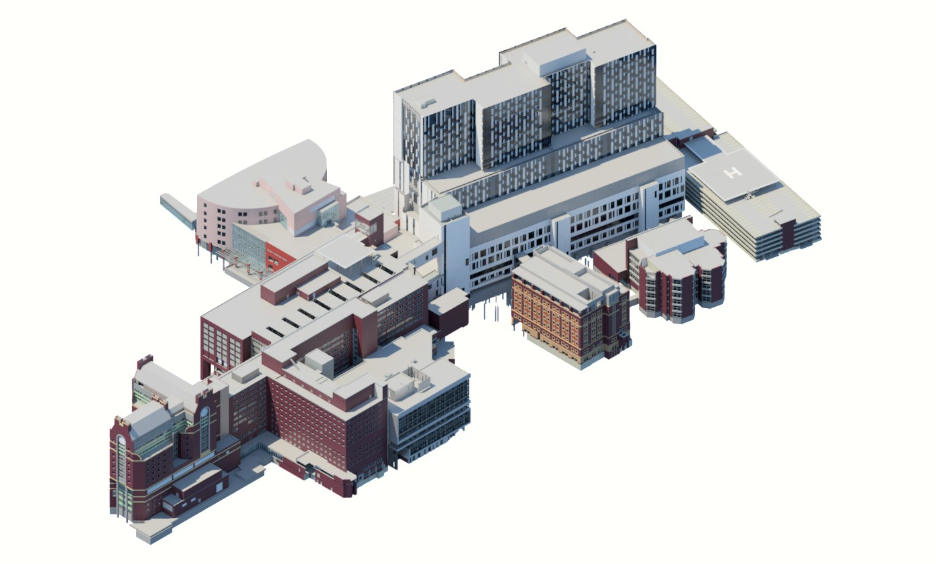
Using this system, we have quantified the total exterior window glass area across the Columbus campus and identified the capacity of every restroom by counting fixtures and partitions. Connecting this database to other systems has expanded and accelerated decision making across the university.
Drawing on lessons from converting existing buildings, extensive work with consultants and a close evaluation of internal operations, the university developed it BIM Project Delivery Standard (PDS), published in 2015. The standard furthered the university’s move toward at BIM-centric approach by requiring all projects over $4 million to be delivered using BIM-enabled processes and to require BIM deliverables.
Lessons Learned from BIM
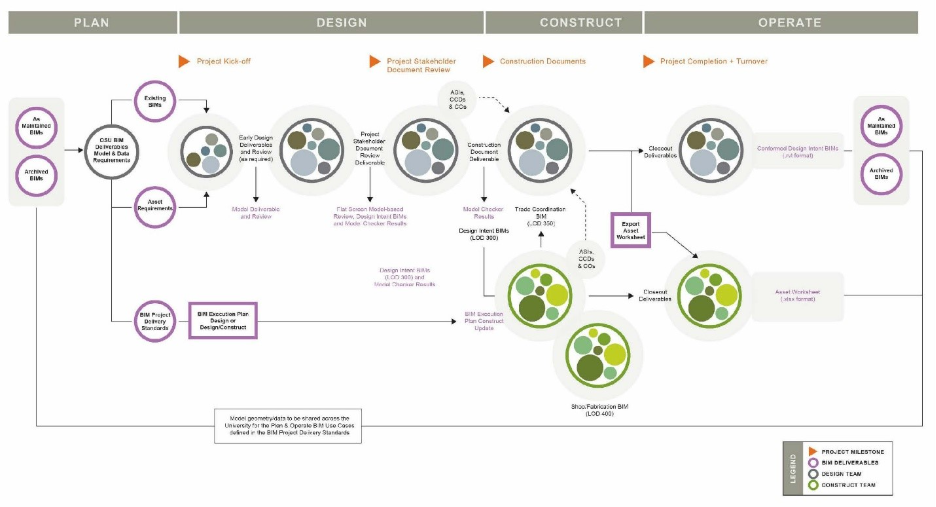
The BIM PDS improves collaboration by answering two major questions: How will the project be executed? And how will the deliverables be formatted? The project teams document execution through a BIM Execution Plan, while the PDS clearly defines the university’s expectations for deliverables. Together, this allows the university and the project teams to collaborate and communicate effectively throughout the project.
Over the last 10 years, more than 55 buildings have been delivered under this standard, giving the university access to fully modeled buildings that serve as the basis for more advanced uses of BIM in the future.
Ohio State has learned several valuable lessons throughout the last 15 years of growing our BIM use. One of the most important lessons has been proper planning and remaining focused on the most critical items.
We have intentionally maintained simplicity in our models and our standards to complete the transition within a reasonable time frame and to manage the resulting ecosystem. These are not design intent models or as-builts; they are “as-maintained” models or Owner Models. That distinction required us to define up front what we needed –– and what we didn’t need –– and to maintain that discipline as the models were built and accepted from project teams.
We also considered what we could realistically maintain over time. Combined with a high level of standardization, significant automation and a commitment to continuous improvement, this approach has sustained our success.
Lastly, strong partnerships inside Ohio State, along with collaboration with outside experts and consultants, have helped us understand both the why and how of becoming a BIM-centric university.

Joe Porostosky serves as the Director of Facilities Information and Technology Services (FITS) at The Ohio State University (OSU) where his team is responsible for maintaining 44 million square feet of space drawings and data, developing OSU’s Enterprise GIS, and leading the BuckeyeBIM Initiative.